Why AI Is The Best Cure For Healthcare
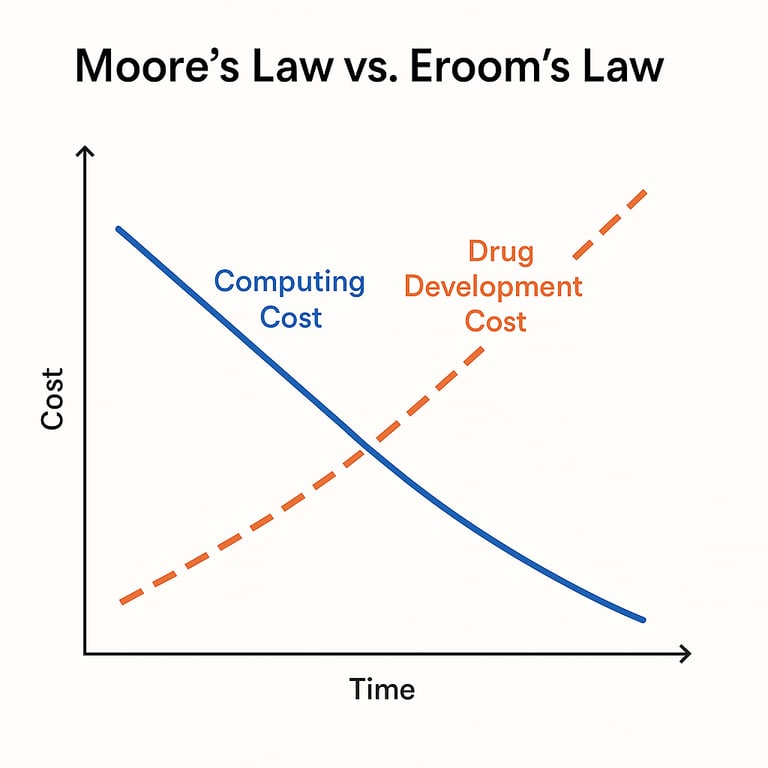
One curve is racing downward, making technology faster and cheaper. The other is climbing relentlessly, dragging healthcare costs higher each year. This blog unpacks the strange tale of Moore’s Law vs. Eroom’s Law — and how AI might be the unlikely hero that bridges the gap.
Vighnesh Chavan
7/18/20252 min read
Why Healthcare Is Bleeding Out
We live in a paradox: while technology gets faster and cheaper, healthcare gets slower and more expensive.
To explain that, let’s meet two characters:
Moore’s Law
Coined by Intel co-founder Gordon Moore, it predicts that computing power doubles every 2 years while cost halves. For decades, this law held true — powering smartphones, the internet, and now, AI.
Eroom’s Law
That’s Moore spelled backwards — fitting, because it says the opposite: The cost of developing new drugs has doubled every 9 years, despite advancements in biotech.
Moore’s Law: More computing, less cost.
Eroom’s Law: More drugs, more cost.
This tension between rising healthcare costs and declining computation costs is the opportunity of our time.
The Prescription: AI + Cheap Compute
Thanks to Moore’s Law, the compute power needed to train large AI models is becoming more affordable than ever. And that unlocks a new frontier for healthcare innovation.
Instead of brute-forcing drug discovery or relying on exhausted doctors, we can now offload intelligence to machines that never sleep, forget, or burn out.
Here’s how AI is already cutting costs in healthcare:
AI Diagnostics
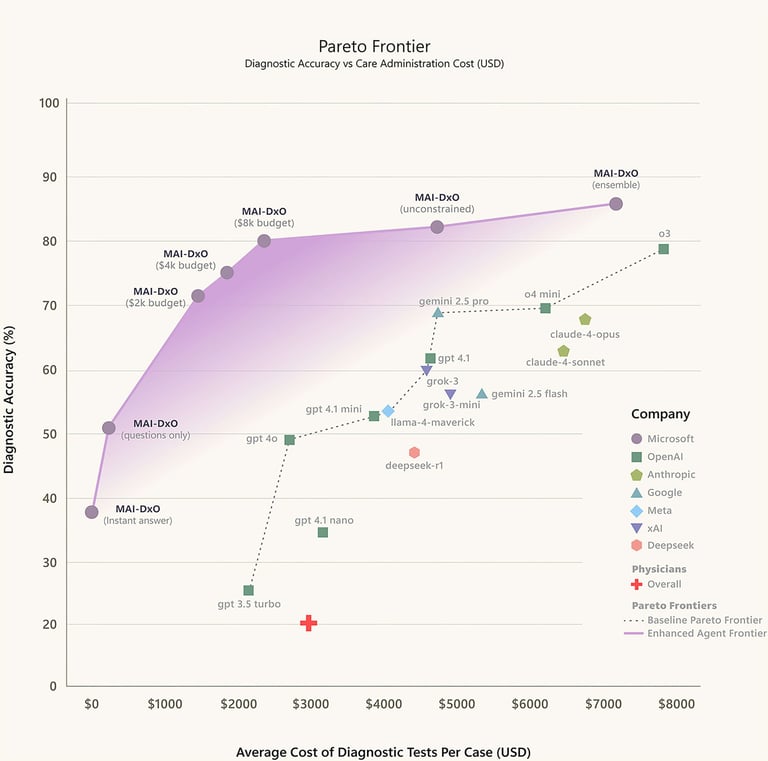
Agents like Microsoft’s can reduce unnecessary tests, misdiagnoses, and late-stage interventions.Medical Imaging
Radiology models detect abnormalities faster and often with greater precision than human eyes.Drug Discovery
AI models like AlphaFold and BioGPT can predict protein structures, cutting years and billions from R&D pipelines.Administrative Automation
AI automates insurance claims, patient intake, and scheduling — freeing up human time.Predictive Care
Algorithms flag high-risk patients before they crash into the ER — turning reactive care into proactive care.
Why This Matters — Especially Now
In the next decade, healthcare demand will skyrocket due to aging populations and chronic diseases. But we can’t scale human doctors and drug trials at the same rate.
What we can scale? Intelligence.
Thanks to AI and the falling cost of computation, we can finally start to flatten — and maybe reverse — the healthcare cost curve.
We’re not just talking about fancy robots or hospital chatbots.
We’re talking about infrastructure-level intelligence that works behind the scenes, like a silent co-pilot to every clinician, pharmacist, and public health planner.
Closing Thought
The question isn’t if AI should be in healthcare — it’s how fast we can integrate it before the system breaks.
Moore gave us the exponential curve.
Eroom warned us where we’re headed.
Microsoft just gave us a glimpse of the solution.
Now, it’s time to scale it.
In July 2025, Microsoft quietly changed the game.
They launched an AI diagnostic agent named MAI-DxO that, in blind tests, diagnosed clinical cases with four times the accuracy of a human doctor. Yes — 4x better. Not faster. Not cheaper. Smarter.
MAI-DxO wasn’t just reviewing symptoms. It was analyzing vast medical datasets, imaging reports, and even subtle trends in patient history to arrive at its decisions, in seconds.
That kind of breakthrough isn’t just a tech flex. It’s a lifeline.
Because the global healthcare system is in trouble — and AI might be the only agent that can save it.